
Health Benefits of Karela (Bitter-Gourd)

The health benefits of karela (bitter-gourd) are greater than those of many vegetables. Karela’s bitter taste is generally attributed to the quinine it contains. Cooked bitter gourd stimulates the appetite, cleanses the liver, purifies the blood, and provides many other benefits.
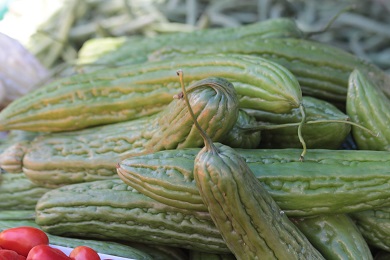
Grown in the Indian subcontinent and parts of Asia, Africa, and South America, karela (aka bitter-melon, kaakarakaya in Telugu) is unsavory yet very nutritious and healthy. Karela comes in many different varieties and is similar in shape to a cucumber. In the Indian grocery stores in the US, you’ll find the the Indian, dark green, spiky variety, while in the Asian stores, you’ll find the lighter-green bitter-melons that are larger with a bumpy peel.
A really delicious type of karela is kantola or kakrol (aa-kaakarakaya). These are small, round or oval with tiny, prickly spikes, and are not bitter at all or only slightly bitter. These taste great sliced into thin chips and either stir-fried or deep-fried. Fresh kantola are a rare sight in the US but are widely available frozen.
In South India, karela and kantola, are soaked overnight in brine or buttermilk and sundried, and then deep-fried as needed, and like pappadums, served as crunchy accompaniments or added to soups and stews. These vadiyams or vadams are available in Indian grocery stores.
Karela and Health
Quick Facts
Bitter melon juice provides many benefits. In Indian medicine, such as Ayurveda, bitter-gourd juice (from the gourd or leaves) has long been used as a remedy for diabetes and liver problems. Karela juice is also used to treat skin problems like psoriasis, and is generally good for skin health as it purifies blood.
Ayurvedic doctors also prescribe bitter-gourd juice for digestive problems and to boost immunity. A glass of karela juice with a dash of lemon, taken on an empty tummy, is supposed to improve general health as well as skin health.
Karela contains a chemical called charantin which reduces high blood glucose levels, and hence the best home remedy for diabetes (as a curry or juice).
Pregnant women are advised to avoid this vegetable as it can cause miscarriages.
Along with fiber, karela contains several vitamins, minerals, and trace elements like vitamin C, iron, zinc, potassium, calcium, and phosphorus. Like most vegetables, bitter gourd benefits include the fact fact that it is low in calories, and as such great for weight-loss. Studies show that bitter-melon extract can help prevent breast cancer.
It makes sense to include karela in your diet as it offers so many health benefits.
Cooking Tips
- Use tender, green karela for best taste. Though the bitterness varies depending on the variety, usually, tender karela are less bitter. If using tender karela, you can use them with the pith and seeds; otherwise, remove the pith and seeds.
- To reduce the bitterness, cut the karela and rub salt and/or lime juice on the pieces and let sit for 1-2 hours; squeeze out the water before cooking.
- To reduce bitterness, add tamarind, jaggery, grated coconut, lime/lemon juice to the curries or combine with beans and legumes like chickpeas.
- To make them more palatable, stir-fry, deep-fry, or stuff with potatoes and other spices, or add them to lentil and vegetable soups and stews.
- Wrap the karela in plastic and store in the refrigerator to keep them fresh for upto a week.
Sources
Home Remedies for Common Ailments, H.K. Bakhru
http://www.nydailynews.com/lifestyle/health/2010/02/24/
2010-02-24_bitter_melon_shows_promise_in_protecting_against_treating_breast_cancer_study.html
http://sfp.ucdavis.edu/research/AsianVeg/cucurbit.htm
http://food.oregonstate.edu/glossary/b/bittermelon.html
Category: Health